

Image Credit: Nita Creekmore
by 2025-2027 Associate Member Nita Creekmore
As I walk around one classroom, students with their noses deep in a book, are comfortably reading in their chosen areas. Some of the students are sitting on the floor. Some have found a corner in the room. Some lay down on the rug and others are sitting comfortably on pillows reading. The timer goes off and I hear groans, “not yets” and “no’s” throughout the room. It’s clear that the students do not want that independent reading time to end. They are begging for more time to read, get into partners to discuss their books—they want to dig into the characters in their books, have book talks and synthesize their reading. After talking to the teacher, these students are some of the same students at the beginning of the year who stated they hated reading. Now, ending independent reading time saddens them and they want more of it.
Entering into another classroom, I see a teacher with a book placed in the nook of their arm reading aloud the words from the lesson, using voice commands for each part of the lesson, students have their worksheets in front of them to answer the text-based questions given to them. They are following along with the teacher waiting for the next task from the lesson. The students are doing the work, but engagement is low. There are deep breaths, rolling of their eyes, and hesitancy to finish the one page reading passage—one they do not connect with—to answer the questions. The overall tone of the classroom is boredom and compliance. After talking to this teacher, I hear frustration and disempowerment. If we want students to become lifelong readers and enjoy reading, when do they actually get to read? Independent reading is not time away from instruction, nor is it a quick add on if there is extra time in the schedule. Independent reading provides practice, choice, and cultivates joy. Independent reading is an essential component of instruction.
Reading Volume & Reading Choice Increases Motivation
When explicit reading instruction happens, students learn reading skills that will aid them in becoming better readers. They acquire the reading skills needed to engage in the act of reading. However, without reading practice of the skills we teach them, how will students get better? Students become better readers by actually reading. Students become better readers by being given time to read and having choice in their reading. “Every child, every day should read something they choose.”, (Krashen, 2004) When a child chooses a book, their engagement increases significantly. It allows them to practice the reading skills learned and have liberation in their reading. It gives them freedom to read what interests them, books that provide windows, mirrors, and sliding glass doors, (Bishop,1990) which increases reading engagement. It sets the foundation for lifelong reading, but it also enhances the following skills: increased and enhancement of vocabulary, improvement of reading comprehension, grammar increased, fluency and so many other reading skills. Due to the fact that students are reading for pleasure, it doesn’t feel like “work” or another thing to do. It is the act of reading freely where they actually feel joy. Joy is their motivation and that joy increases engagement.
Building Reading Stamina
Just as the initial classroom described above, the one where students are sprawled out in their special places reading their self-chosen texts, when the independent reading time is over, the emotion of disappointment permeates throughout the room. They want to keep reading. The sacred independent time is helping to build reading stamina. While short passages may help to showcase specific skills when teaching reading or give a quick assessment into how a reader is learning and growing, longer texts help students to sustain attention, navigate longer texts, think critically, build comprehension, and build cognitive endurance. With the heavy integration of technology in education, although it can have its place, the attention span of our students have decreased. Lodge and Harrison (2019) stated in, The Role of Attention in Learning in the Digital Age, that attention has been implicated as a cognitive function that has been negatively impacted by use of digital technologies for learning. Educators can increase the cognitive function of their students by giving them reading practice through independent reading without the use of technology. In order to counteract the effect that technology has on the brain we must build reading stamina in our students. We must do that through sacred independent reading time.
Supports Identity
Independent reading doesn’t just help us to practice reading, increase motivation, and stamina, but it also teaches us how to understand ourselves and the people around us.
When students are reading independently, they must have access to a wide variety of diverse books to read inside and outside their identity bubbles. When students have access to diverse books, independent reading becomes an opportunity to develop both literacy and humanity. When students and even adults see [themselves and] others in books, it can begin to break down barriers that once stood tall. (Creekmore, 2025) Providing students with opportunities to engage with diverse texts broadens both literacy and perspective (Creekmore, 2025). Reading is power and independent reading can help to support student identity. It allows students to see themselves, see others, build empathy, expand perspective and affirm their identity and its intersections.
What Independent Reading Should Look Like
Independent reading has power when we create the conditions for it to thrive in our classrooms. Often it has been a placement as filler time, busy work, or sometimes silent punishment. That does not create the conditions necessary for independent reading to do the important work it is intended to do.
We must ensure the following:
- Intentional time planned. Educators must have intentional time planned for independent reading in the schedule. The students begin to look forward to this time.
- Co-create routines. Before beginning this practice it is essential to co-create routines for this intentional time and set expectations. One way to do this is by slowly increasing independent reading time to build stamina.
- Access to diverse books. Students must have access to many diverse books to be able to provide mirrors, windows, and sliding glass doors for students to see themselves and others in the books they read.
- Allow Student Choice. Give students the agency to choose the books that interest them. This is their time and it makes space for them.
- Conference with students. Allowing space for teacher conferencing to listen for comprehension, connections to text and to get to know our students as readers is essential during this time. This time is also a chance to provide our students with book recommendations that connect with their interests, who they are and who others are.
- Differentiate this time. This time should also provide differentiation for all students. This means that students could be listening to audiobooks, reading with a partner, and/or reading a book in their native language.
- Flexible seating. Students sitting where they want allows them to get comfortable in their classroom community while reading.
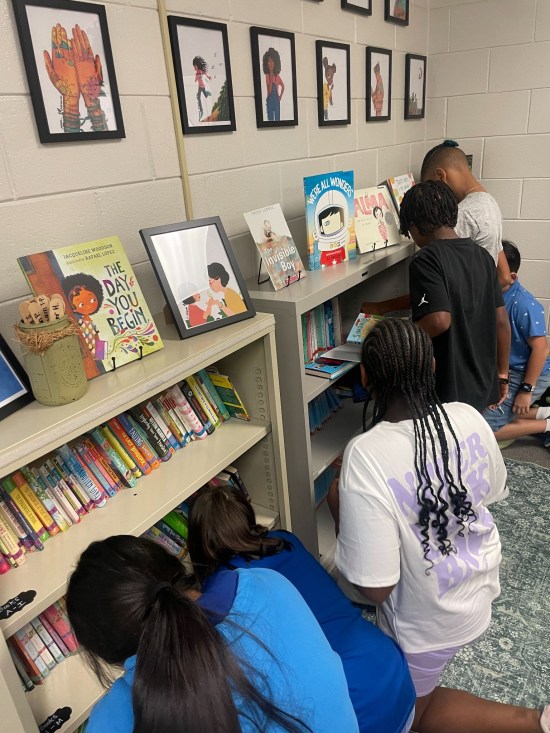
We often say we want students to love reading. We say we want students to become lifelong readers. But if students never have protected time to read books they enjoy, how will that happen? Independent reading isn’t something we squeeze into the day when time allows. This time is a sacred time to increase reading practice to improve reading and to increase the joy of reading. It is one of the most powerful investments we can make in developing confident, capable, lifelong and joyful readers.
References
Creekmore, N. (2025). Read outside your bubble: Expand your bookshelf, expand your world. Jossey-Bass.
Guthrie, J. T., & Wigfield, A. (2000). Engagement and motivation in reading. In M. L. Kamil et al. (Eds.), Handbook of Reading Research (Vol. 3, pp. 403–422). Routledge.
Hirsch, E. D. (2006). The Knowledge Deficit. Houghton Mifflin.
Lodge, J. M., & Harrison, W. J. (2019). The role of attention in learning in the digital age. The Yale Journal of Biology and Medicine, 92(1), 21–28. https://pubmed.ncbi.nlm.nih.gov/30923470/
Krashen, S. D. (2004). The Power of Reading (2nd ed.). Libraries Unlimited.


